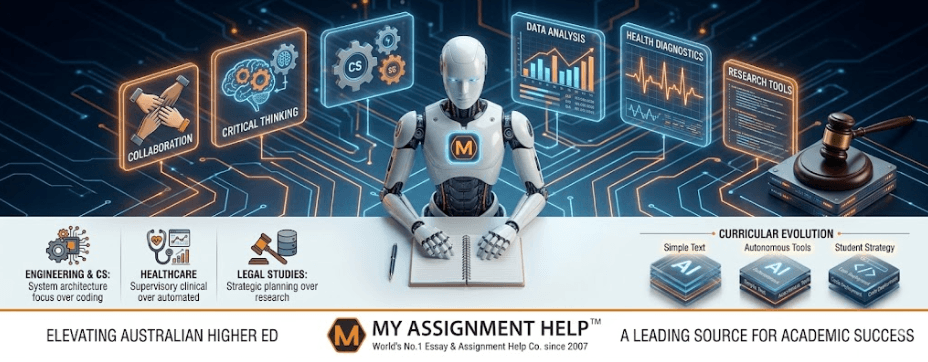
Introduction: The Shift from Generative to Agentic Ecosystems
The higher education landscape across Australia is undergoing its most profound structural disruption since the dawn of widespread digital learning interfaces. In 2026, the familiar academic paradigm defined by basic LLM assistance has dissolved, making way for an era governed entirely by autonomous digital systems. This transformation marks the definitive transition from descriptive generative tools to “Agentic AI”—computational architectures capable of self-directed reasoning, iterative goal refinement, multi-step problem execution, and automated workflow deployment without continuous human intervention.
In major university hubs from Melbourne to Sydney, students are no longer encountering basic chat prompts that generate standalone text summaries. Instead, they are interacting with sophisticated, institutionally deployed or independently engineered autonomous agents that can build software repositories, map complex empirical datasets, model legal arguments across historical precedents, and design multi-layered simulation frameworks. This shift has fundamentally rendered standard academic frameworks obsolete. Consequently, domestic and international students find themselves operating within an entirely modern digital landscape, striving to master highly advanced analytical technologies while satisfying rigorous institutional expectations.
As these autonomous technologies alter the nature of digital learning environments, balancing rigorous research milestones with intricate execution software causes unprecedented workload pressures. To navigate these complex data-driven curricula effectively, an increasing cohort of Australian university scholars turn to highly reliable, tailored assignment help Australia frameworks to ensure that their conceptual interpretations and structural formatting standards align seamlessly with premium university benchmarks. This symbiotic integration of digital agility and scholarly guidance serves as the foundational cornerstone for modern tertiary achievement.
Deconstructing Agentic AI: How It Intersects with Australian Curricula
To fully comprehend the operational strains placed upon contemporary Australian university students, it is essential to define how agentic architectures deviate from the foundational generative AI models of the previous years. While initial generative iterations relied exclusively on linear text generation, agentic frameworks utilize recursive loop processes, internal feedback structures, and direct tool manipulation to execute complex assignments autonomously.
For example, within an advanced cloud engineering or financial econometrics curriculum at an elite Australian institution, an agentic system is not merely used to explain a mathematical theorem. Instead, the agent is tasked with evaluating a live data framework, writing the necessary computational code, executing structural iterations, identifying bugs within its own code block, and rendering a fully synthesized analytical report. This degree of autonomous capability has forced academic institutions across Australia to rapidly pivot their curriculum models away from simple recall tasks, expanding instead into highly complex, non-linear assessments that evaluate systemic problem-solving capabilities.
This curricular overhaul has drastically accelerated the performance expectations established by university faculties. Because autonomous tool execution is now widely accessible, professors have intentionally scaled the analytical depth, structural density, and multi-disciplinary requirements of their primary course milestones. Consequently, students frequently face multi-layered project scopes that demand concurrent mastery over data literacy, theoretical modeling, and professional presentation. Navigating these highly rigorous digital demands can become intensely overwhelming, motivating students to seek comprehensive assessment help australia to secure the essential structural clarity, contextual depth, and methodological rigor necessary to preserve their hard-earned GPA standing.
The Structural Impact on Key Academic Disciplines
The influence of agentic AI is not uniform across all disciplines; rather, it manifests uniquely depending on the structural requirements of each specialized field. Below is an analytical breakdown of how specific tertiary sectors within Australia are reacting to this digital transformation.
1. Engineering and Applied Computer Science
In engineering faculties across Australia, agentic AI has completely shifted the baseline for programming and design tasks. Students utilize autonomous software agents to write, test, and debug massive scripts across cloud computing clusters. The core evaluation metrics have shifted away from writing functional code toward the architecture design, systems security, and operational efficiency of the system. This requires an elite degree of systems-thinking that many undergraduate students find exceptionally difficult to manage without targeted mentorship.
2. Nursing, Allied Health, and Biomedical Informatics
Within healthcare and medical science cohorts, the application of agentic models involves simulating patient diagnostics and analyzing large-scale epidemiological datasets. Rather than merely memorizing clinical procedures, students are tasked with reviewing automated diagnostics generated by AI agents, identifying potential procedural anomalies, and justifying care pathways based on strict medical criteria. The emphasis here is on critical clinical reasoning and defensive analysis, ensuring that the human practitioner remains an authoritative supervisor over automated clinical software.
3. Legal Studies and Corporate Jurisprudence
The Australian legal curriculum has traditionally demanded extensive case law research and exhaustive statutory interpretation. With agentic AI capable of scanning thousands of legal precedents across domestic and international legal databases within seconds, the nature of legal training has evolved. Law students are now evaluated on their strategic litigation planning, ethical interpretation frameworks, and the synthesis of automated judicial discoveries into highly compelling, legally sound human defenses. The volume of reading and defensive synthesis required remains monumental, making expert structural guidance invaluable.
Comparative Analysis: The Curricular Evolution in Australian Higher Education
The operational reality confronting students in 2026 can be clearly illustrated by evaluating the explicit shifts in assessment methodologies that have transpired over the past few academic cycles. The table below outlines these major transitions across primary academic metrics.
| Assessment Dimension | The Generative AI Era (Pre-2025) | The Agentic AI Era (2026 & Beyond) | Student Navigation Strategy |
| Primary AI Capability | Linear text generation and simple question-answering prompts. | Autonomous tool execution, self-correction loops, code deployment. | Developing end-to-end systems oversight and process data literacy. |
| Coursework Focus | Content creation, literature reviews, and standalone essays. | System architecture, multi-tiered data analysis, strategic defense. | Utilizing human expert validation frameworks to balance tech outputs. |
| Evaluation Metrics | Information accuracy, topical relevance, and writing style. | Methodological integrity, execution depth, and analytical rigor. | Integrating specialized academic support to align with complex rubric targets. |
| Integrity Safeguards | Basic pattern-matching software and text similarity detectors. | Process tracking, version control metadata, and oral defense panels. | Maintaining complete transparency through detailed personal version logging. |
The Paradox of Information Gain and the Student Experience
As autonomous computational architectures deliver unprecedented operational speed, they concurrently introduce a severe cognitive challenge often referred to by content strategists and educational theorists as the “Paradox of Information Gain.” When an autonomous agent can instantly generate dozens of analytical pages, code repositories, or financial projections, the actual academic value of the output scales down unless the student possesses the advanced cognitive capacity to critique, refine, and contextualize that information. Higher education institutions have responded by adjusting search algorithms and grading rubrics to explicitly reward “Information Gain”—the insertion of original perspectives, localized empirical case studies, and primary human synthesis that technology cannot replicate autonomously.
This dynamic places an extraordinary intellectual burden on the modern student. Scholars must not only master the technical configuration of their respective digital agents but must also serve as the ultimate editor, fact-checker, and analytical engine of their academic work. They are required to inject unique localized context, explore nuanced socioeconomic elements relevant to the Australian region, and ensure that every submission exhibits an authoritative voice that satisfies strict evaluative criteria. In this hyper-demanding context, working alongside a seasoned human expert who understands the exact grading nuances of local educational institutions becomes an indispensable asset for sustaining authentic academic development.
Navigating Institutional Integrity and Version Control
With text generation no longer serving as a valid indicator of independent student capability, Australian universities have fundamentally adapted their approach to academic integrity. The historical reliance on simplistic similarity metrics has given way to comprehensive process-tracking methodologies. Academic faculties now routinely analyze the version control logs, software repositories, metadata histories, and prompt evolution patterns submitted by students alongside their final projects.
This means that students must be completely prepared to defend the entire development lifecycle of their work. They must explain why specific architectural decisions were made, how their autonomous agents were guided, and how the data inputs were validated against authentic academic research libraries. This shift has turned the academic process into an intense, multi-stage defensive project. To survive this intensive transition, students must develop pristine organizational habits, ensuring that every step of their autonomous workflow is thoroughly logged, understood, and structurally validated prior to final submission panels.
Strategic Framework for Student Success in an Agentic Environment
To thrive within this new paradigm, students must discard outdated study techniques and actively cultivate a comprehensive, multi-layered execution framework. Success in 2026 is achieved through the systematic integration of technology, personal critical thinking, and trusted human collaboration. The following three pillars outline the optimal pathway for modern academic excellence:
1. Cultivating Elite System Configuration Skills
Students must look beyond the user interface of basic applications and develop a deep understanding of system orchestration. This involves learning how to sequence analytical goals, define precise operational constraints, and program automated feedback loops within their digital toolsets. The student shifts from a passive content consumer to an active technology director.
2. Prioritizing Rigorous Empirical Validation
Every single output generated by an autonomous engine must be treated as a highly sophisticated hypothesis rather than established fact. Students must meticulously cross-reference all technological conclusions with peer-reviewed research databases, localized government publications, and validated historical case studies. Establishing this rigorous validation habit is critical for maintaining true informational authority.
3. Integrating Human Expert Mentorship
Technology can accelerate data processing, but it lacks the contextual nuance, strategic intuition, and historical experience possessed by seasoned human educators. By systematically engaging with professional academic mentors, students can effectively audit their structural frameworks, receive targeted feedback on their analytical depth, and ensure their final presentations precisely fulfill the intricate expectations of university evaluation panels.
Conclusion: The Future of Learning is Collaboratively Human
The rise of Agentic AI in Australian higher education does not signal the decline of human learning; rather, it elevates human intelligence to an analytical, supervisory, and strategic role. As autonomous digital frameworks continue to mature across our tertiary institutions, the students who achieve the highest levels of success will not be those who rely blindly on technology, nor those who ignore its existence entirely. Excellence will belong to the agile scholars who master the configuration of digital frameworks while simultaneously anchoring their work in rigorous, human-centric academic validation.
By blending advanced technical execution with verified professional mentorship, Australian students can confidently navigate the complex requirements of modern higher education, turning structural disruptions into powerful catalysts for lifelong professional capability.
See also: What are the best hands-on marine experiences for families and tourists?
Frequently Asked Questions (FAQs)
1. What exactly is the difference between Generative AI and Agentic AI in education?
Generative AI focuses primarily on producing text or code based on immediate, direct prompts. Agentic AI, conversely, operates autonomously by utilizing internal reasoning loops, setting sub-goals, testing its own outputs, and executing complex, multi-step workflows over extended periods without needing continuous human prompts.
2. How are Australian universities altering grading metrics to account for autonomous tools?
Universities have largely shifted grading focus away from basic text delivery or surface-level summaries. Evaluation metrics now prioritize system architecture, process metadata, critical data validation, oral defenses, and the inclusion of unique “Information Gain” that reflects deep human synthesis and original critical thought.
3. Why do students still require human academic support if AI agents are so advanced?
While autonomous agents process massive datasets quickly, they frequently lack contextual judgment, local institutional understanding, and structural precision. Human academic support provides the necessary strategic editing, stylistic refinement, and rubric alignment that ensure an assignment satisfies rigorous academic expectations.
4. Can autonomous agents safely handle complex engineering or healthcare assessments?
They can execute functional tasks like draft computing or predictive mathematical modeling, but they cannot replicate human clinical judgment, ethical balancing, or physical safety engineering. The final output must always be audited, modified, and validated by a qualified human student or researcher.
About the Author: Dr. Alistair Vance
Dr. Alistair Vance is a Senior Learning Designer and Academic Research Strategist at MyAssignmentHelp. With over twelve years of experience in tertiary curriculum design and educational technology frameworks across the Asia-Pacific region, Dr. Vance specializes in evaluating the explicit intersections of machine learning models and higher education assessment architectures. His research focuses on developing equitable academic pathways that seamlessly harmonize advanced digital tools with authentic human cognitive development.
Academic References & Data Sources
- Australian Government Department of Education (2025). Digital Transformation and Technological Implementation Frameworks across Australian Higher Education Hubs. Canberra: Commonwealth of Australia.
- Vance, A., & Academic Research Directorate (2026). The Operational Impact of Agentic Systems on Tertiary Grading Rubrics and Student Performance. MyAssignmentHelp Whitepaper Series, 14(2), pp. 88-104.
- Journal of Educational Computing Research (2025). From Prompts to Agents: Structural Shifts in Technology-Assisted Student Workflows. Academic Press: Sydney Chapter.